

If you’ve ever ordered something for your dog online and thought…
- “This looked bigger in the photo.”
- “Why is this harness rubbing their armpits?”
- “How is this jacket too tight AND too long at the same time?”
…you’re not alone.
Dog wearables are one of the most useful parts of modern pet care — but only when they fit properly.
A good fit means your dog gets:
- better comfort
- better movement
- better warmth (or cooling)
- less rubbing
- fewer escape attempts
- safer walks
And a poor fit means the opposite — irritation, restricted breathing, uneven pressure, or a dog that refuses to wear it at all.
So today we’re going to break it down in the simplest, clearest way possible:
how to measure your dog properly for wearables — jackets, pajamas, harnesses, boots, and custom pupwear.
Why Fit Matters More Than Style
At Boston Made Pets, we love style. But pupwear isn’t just fashion.
Wearables sit in sensitive, high-motion zones:
- shoulders
- ribs
- chest
- neck
- hips
- paw pads
When measurements are “close enough,” the dog feels it immediately — because they don’t have the ability to adjust it like humans do.
A proper fit should feel “invisible.”
Meaning: your dog should be able to move naturally without thinking about it.
What You Need Before Measuring
You don’t need professional tools.
Here’s all you need:
✅ Soft measuring tape (tailor tape)
✅ Notebook / phone notes
✅ 2 minutes of patience
✅ Treats (high value works best)
If you don’t have a measuring tape, use string and then measure the string against a ruler.
The 5 Measurements Every Dog Owner Should Know
1) Neck (Collar Line)
Measure around the base of the neck where a collar naturally sits.
Tip: You should be able to fit two fingers under the tape.
Neck measurement matters for:
- coats/jackets
- sweaters
- hoodies
- pajamas with higher collars
- harnesses that sit higher
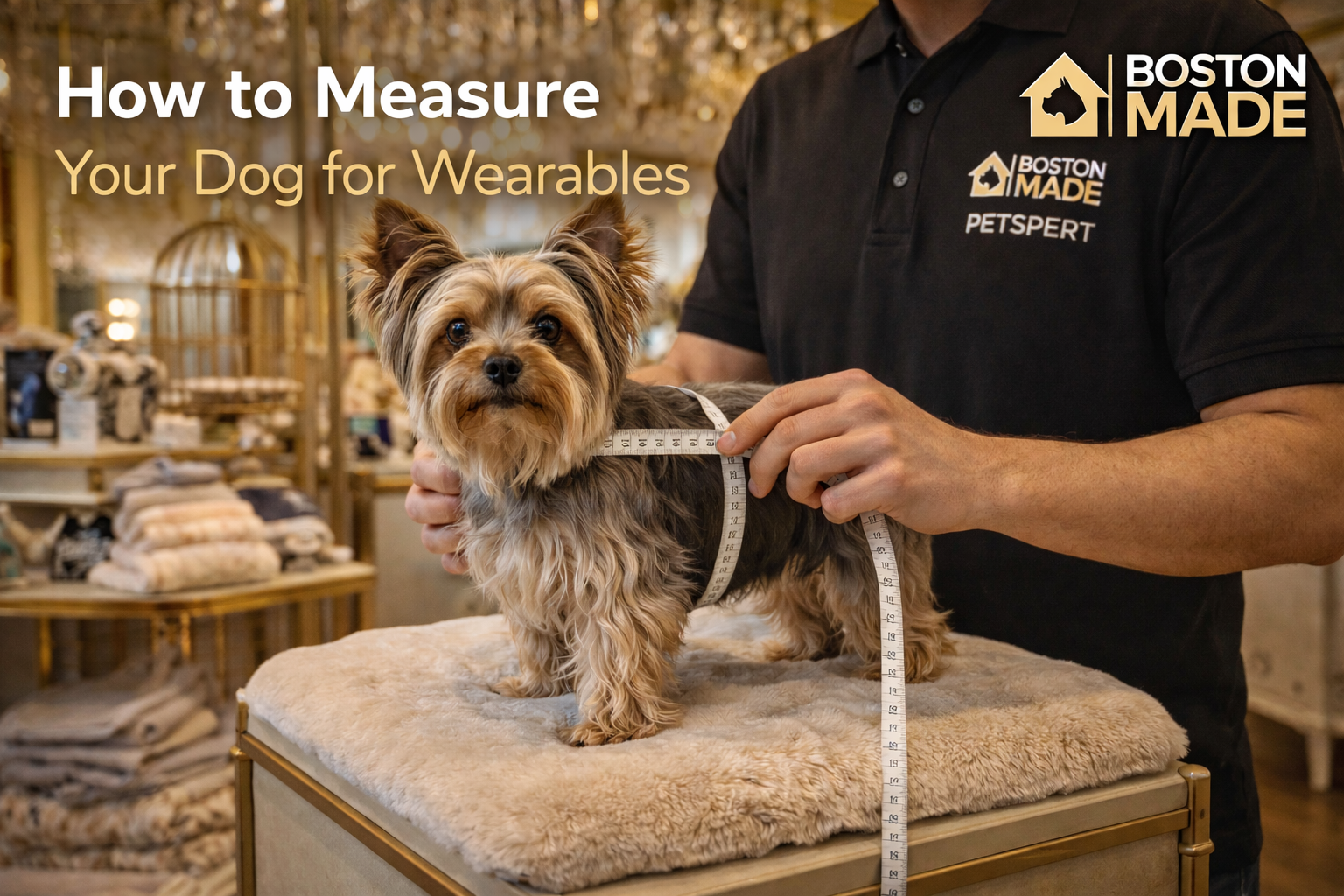
2) Chest / Girth (Most Important)
This is the most critical measurement in dog wearables.
Measure the widest part of your dog’s ribcage — usually just behind the front legs.
This measurement matters for:
- harnesses
- jackets
- pajamas
- onesies
- cooling vests
- rain coats
If you only take ONE measurement, take this one.
3) Back Length
Measure from the base of the neck (where collar line begins) to the base of the tail.
This measurement matters for:
- coats
- hoodies
- sweaters
- pajamas
- rain gear
Reality check: Some dog breeds are long-bodied (like dachshunds). Others are compact (like french bulldogs). Back length matters.
4) Front Leg / Shoulder Clearance
This is why some jackets look perfect but still cause rubbing.
Check how much space exists behind the dog’s front legs. If clothing rides up into that zone, irritation happens fast.
This matters especially for:
- running dogs
- high energy dogs
- dogs with broad chests
5) Paw Width (For Boots)
Paw sizing is tricky.
Place your dog’s paw on paper while they’re standing. Trace and measure width.
This matters for:
- boots
- paw protectors
- traction wearables
Your dog’s paw spreads under weight — so standing measurement is key.
How Tight Should Wearables Be?
Here’s the standard Boston Made Pets rule:
✅ snug enough not to shift
✅ loose enough to move freely
Use the two-finger test:
- harness straps: 2 fingers
- jackets: 2 fingers
- pajamas: 1–2 fingers depending on stretch
If you can fit 4 fingers, it’s too loose.
If you can’t fit 1 finger, it’s too tight.
The “Sit Test” (Instant Fit Test)
Once you put on the wearable, do this quick test:
- Have your dog sit
- Have your dog stand
- Have your dog take 5 steps
- Watch shoulder movement
- Watch for rubbing
A good fit:
✅ shoulders move naturally
✅ no lifting at the belly
✅ no twisting straps
✅ no choking
✅ no paw stepping into fabric
The Biggest Fit Mistakes People Make
Here are the big ones:
❌ Mistake 1: Measuring while the dog is lying down
Dogs compress when lying down, changing chest size.
❌ Mistake 2: Guessing the breed size
“Medium” is meaningless across brands.
❌ Mistake 3: Ignoring chest measurement
Chest fit controls the whole wearable.
❌ Mistake 4: Buying too big “so they can grow into it”
Dogs don’t grow into discomfort.
Fit = Safety
This part matters.
A harness that doesn’t fit can:
- create pressure points
- restrict breathing
- cause shoulder strain
- allow backing out and escaping
A jacket that doesn’t fit can:
- trap moisture in the wrong places
- restrict movement
- create skin irritation
Fit isn’t just comfort — it’s protection.
Boston Made Pets: Why We Take Fit Seriously
We design wearables because dogs deserve better than cheap, throwaway products.
They deserve:
- intentional craftsmanship
- thoughtful sizing
- premium materials
- gear that’s built for real life (not just photos)
Because when your dog wears something that fits right, they don’t just look better…
They feel better.
Closing
If you ever feel unsure, start with the three core measurements:
✅ Neck
✅ Chest/Girth
✅ Back Length
That alone will eliminate 90% of sizing issues.
And from there, you can build your dog’s wearable collection with confidence — season after season.