

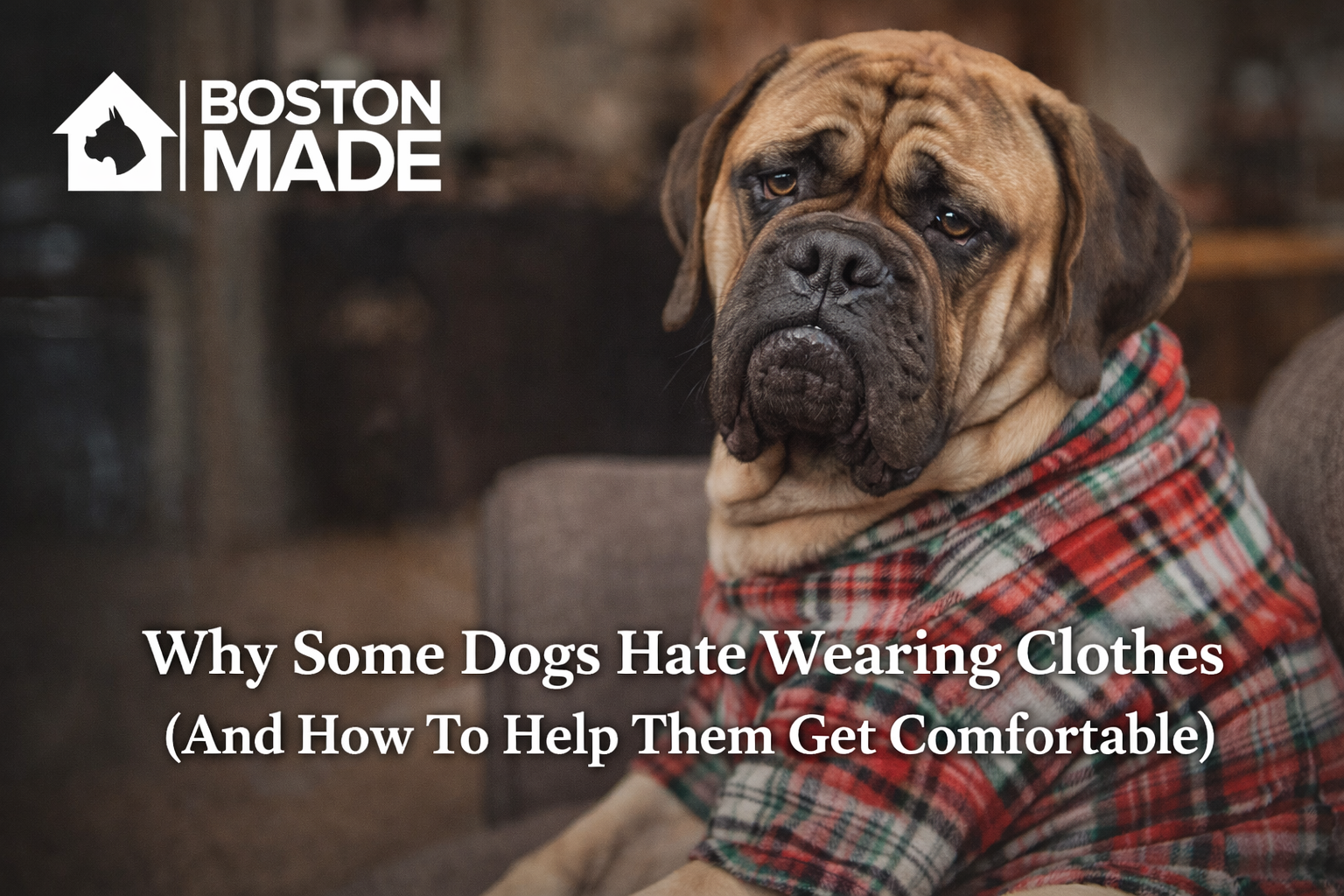
It’s not stubbornness. It’s sensory overload, movement restriction, and trust.
Some dogs will wear anything.
You put pajamas on them and they’re instantly like:
“Cool. Let’s go.”
Other dogs?
They act like you just turned them into a statue.
They freeze.
They stare at you.
They refuse to walk.
They fall over dramatically like a fainting goat.
They start biting at the sleeves.
They roll around like they’re trying to escape a monster.
And if you’re a loving dog parent, you’ve probably thought:
“Am I stressing them out?”
“Do they hate me?”
“Is this uncomfortable?”
“Is this just… not for them?”
At www.bostonmadepets.com, we take this seriously because dog wearables should never feel like a battle.
So let’s break down why some dogs hate wearing clothes — and the step-by-step Boston Made Pets method for helping them feel confident and calm in wearables.
First: Dogs Experience Clothing Very Differently Than Humans
Humans wear clothing constantly.
Dogs don’t.
So when you put clothing on a dog, you’re changing:
- how their fur feels
- how air flows across their skin
- how their body moves
- what pressure points they feel
- how they interpret “freedom”
- how they read your behavior
A dog isn’t thinking:
“This looks cute.”
They’re thinking:
“What is touching me… and why can’t I move the same way?”
This is why we say at www.bostonmadepets.com:
Clothing must feel normal — not forced.
The 7 Most Common Reasons Dogs Hate Wearing Clothes
1) The clothing is too tight
This is #1.
If it restricts shoulder movement, presses the neck, or pinches the chest, your dog may:
- freeze
- pancake
- refuse to walk
At www.bostonmadepets.com, we never treat “freezing” as drama. We treat it as communication.
2) The clothing is too loose
This surprises people.
Loose clothing can:
- twist
- slide
- flap
- create constant shifting sensations
For many dogs, loose clothing feels scary because they can’t predict it.
3) The fabric is uncomfortable
Your dog may hate clothing because of:
- scratchy seams
- stiff material
- loud crinkly fabric
- static shocks
- overheating
Comfort is sensory. And dogs are sensory animals.
That’s why at www.bostonmadepets.com, fabric selection is one of our biggest focus areas.
4) Your dog feels “trapped”
Some dogs interpret clothing as restraint.
This is especially common for:
- rescue dogs
- anxious dogs
- dogs with past trauma
- very independent dogs
They may panic, chew, or attempt to flee.
5) The sleeves/leg openings are wrong
Leg openings can cause instant rejection if they:
- rub armpits
- pull during walking
- twist the legs
- restrict stride
A wearable might look fine standing still but fail in motion.
6) They don’t know what it is
This is huge.
Dogs can be suspicious of new objects, especially ones that go over:
- head
- face
- legs
So clothing can trigger a fear response, not because it’s uncomfortable, but because it’s unfamiliar.
7) You introduced it too fast
If the first experience with clothing is:
- rushed
- forced
- frustrating
- associated with restraint
Your dog stores that emotional memory.
At www.bostonmadepets.com, we teach:
start slow, reward often, end early.
The Boston Made Pets “Clothing Confidence Method”
Here’s the step-by-step process we recommend at www.bostonmadepets.com for getting a dog comfortable with clothing.
✅ Step 1: Let them investigate it
Place it on the floor.
Let them sniff it without pressure.
Reward: treat + praise.
Goal: clothing becomes “normal object.”
✅ Step 2: Touch their body with it (no wearing yet)
Gently brush the clothing against:
- shoulder
- chest
- back
Reward immediately.
This introduces the feeling without restraint.
✅ Step 3: Put it on for 15–30 seconds only
Yes. Seconds.
Then remove it.
Reward + play.
Why?
Because you want the dog to learn:
Clothing appears → good things happen → clothing disappears
That creates trust.
✅ Step 4: Increase time slowly
30 seconds → 2 minutes → 5 minutes → 15 minutes
Never jump from “first time” to “overnight pajamas.”
✅ Step 5: Add movement
Have them:
- walk in the living room
- do a treat trail
- do a short calm activity
Movement builds confidence.
✅ Step 6: Make clothing part of a routine
Routine creates calm.
Example:
- pajamas go on
- water bowl filled
- lights dim
- bedtime
Over time your dog links clothing to safety.
What NOT to Do (Even If You Mean Well)
At www.bostonmadepets.com, here are the mistakes we want you to avoid:
🚫 Don’t laugh or call them dramatic
They’re communicating discomfort or confusion.
🚫 Don’t leave it on for hours on day one
That can create panic and permanent rejection.
🚫 Don’t ignore fit issues
If clothing twists, rubs, or restricts movement — it’s a fit problem.
Fit is not negotiable.
🚫 Don’t punish chewing or rolling
Redirect. Remove the item. Start over slower.
The #1 Rule: Your Dog Should Still Look Like Your Dog
When clothing fits correctly, your dog should:
- move normally
- have full shoulder freedom
- walk without hesitation
- be able to sit and lay down naturally
Clothing should support your dog’s life — not interrupt it.
At www.bostonmadepets.com, we build wearables that make dogs feel better, not weird.
Final Thought: Confidence Is the Real Goal
The goal isn’t to “force your dog into outfits.”
The goal is:
✅ comfort
✅ trust
✅ calm
✅ movement
✅ safety
And when clothing is introduced correctly, your dog can actually enjoy it.
That’s the Boston Made Pets approach — fit-first, comfort-first, dog-first.
For more wearable education and fit guides, visit www.bostonmadepets.com.
why dogs hate clothes, dog won’t walk in clothes, how to get dog used to clothes, dog pajamas training, dog clothing anxiety, dog wearables comfort, dog clothing fit issues, dog sensory overload clothing, dog freezes in clothes, dog chews pajamas, dog clothing introduction, dog clothing routine, calming dog wearables, dog clothing training guide, dog pajamas comfort, dog clothing fit guide, dog clothes rubbing armpits, dog pajamas sizing, Boston Made Pets, www.bostonmadepets.com