

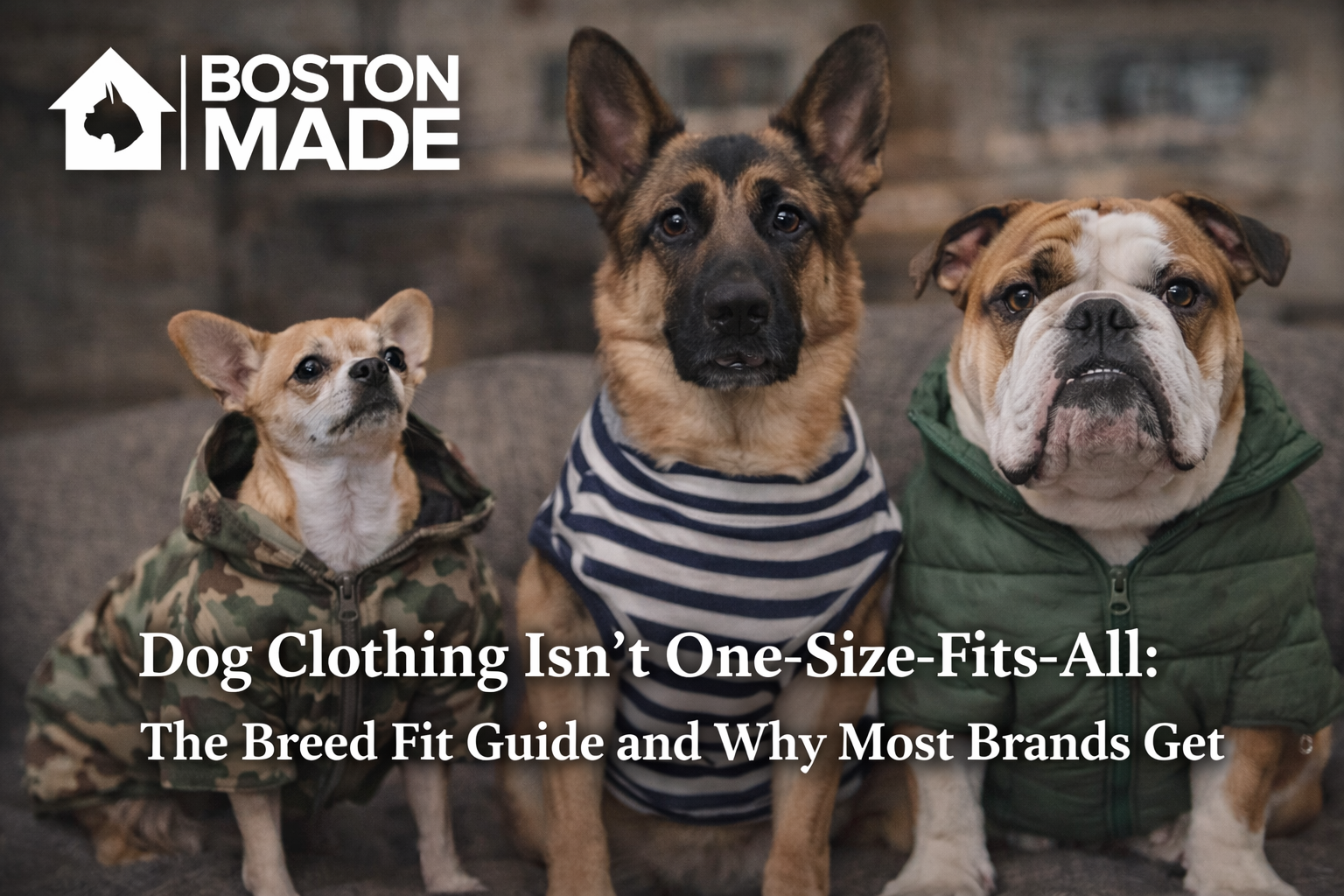
Your dog isn’t “medium.” Your dog is built differently — and their clothing should respect that.
Let’s say you’ve ever bought dog clothing online.
You picked a size.
You followed the chart.
You measured.
You ordered.
And when it arrived…
It technically fit… but not really.
Maybe it was:
- too tight in the chest but loose in the belly
- too long in the back but short in the legs
- riding up into the neck
- bunching up behind the shoulders
- twisting during walks
- rubbing the armpits
- or your dog just froze like: “Absolutely not.”
That moment is frustrating, but here’s the truth:
The problem usually isn’t your dog.
The problem is the idea that dog bodies fit “standard sizes.”
At www.bostonmadepets.com, we’re obsessed with one thing:
✅ fit that actually works in the real world — on real dogs.
And one of the most important things pet parents can understand is this:
Dog clothing doesn’t fail because it’s ugly.
It fails because it was never designed around body variety.
The Big Lie: “Small / Medium / Large”
Most sizing systems assume dog bodies scale evenly.
But dogs don’t scale evenly.
Some dogs are:
- long
- short
- wide
- narrow
- muscular
- fluffy
- lean
- round
- deep-chested
- broad-shouldered
And those traits change everything about how clothing fits.
So when a brand says “M = 15–25 lbs,” that’s not sizing.
That’s gambling.
At www.bostonmadepets.com, we believe clothing should fit the dog’s structure, not just their weight.
Why Breed Fit Matters More Than Weight
Two dogs can weigh the exact same amount and fit totally different.
Example:
- a 15 lb stocky Frenchie
vs - a 15 lb lean Mini Poodle
Same weight.
Different bodies.
Different fit needs.
This is why Boston Made Pets focuses heavily on measurement-based fit logic, not just weight guesses.
The 4 Main Dog Body Types (And How Clothing Fits Each)
Let’s simplify the entire dog apparel world into 4 fit categories.
Body Type #1: The Long-Back Dog
Examples:
- Dachshund
- Corgi
- Basset Hound mixes
Fit problems:
- shirts too short in back
- belly coverage wrong
- legs/armholes misaligned
- clothing rides forward
Boston Made Pets Fit Tip:
Look for wearables with balanced back length and a cut that stays centered. At www.bostonmadepets.com, we prioritize designs that reduce “ride-up.”
Body Type #2: The Deep-Chest Dog
Examples:
- Greyhound
- Whippet
- Doberman
- Boxer mixes
Fit problems:
- chest tightness
- belly too loose
- neck gap
- twisting due to narrow waist + deep chest
Boston Made Pets Fit Tip:
Deep-chested dogs need shaped chest space without sloppy waist space. That’s the difference between “fits” and “fits well.”
Body Type #3: The Broad-Chest / Thick-Shoulder Dog
Examples:
- French Bulldog
- English Bulldog
- Pit mixes
- Boston Terrier
Fit problems:
- chest too tight
- shoulders restricted
- neck area pressure
- clothing becomes stiff because it’s stretched
Boston Made Pets Fit Tip:
These dogs need shoulder freedom. At www.bostonmadepets.com, we view the shoulder area as the #1 mobility zone for fit comfort.
Body Type #4: The Petite / Narrow Dog
Examples:
- Yorkie
- Chihuahua
- Maltese
- Toy breeds
Fit problems:
- neck too wide
- sleeves too long
- fabric bunching
- cold sensitivity amplified
- “fit looks right but feels wrong”
Boston Made Pets Fit Tip:
Toy breeds need lightweight comfort and accurate chest sizing. Too much fabric becomes a burden.
The Most Common Breed Fit Problems (By Breed)
Now let’s get specific — because this is where pet parents feel seen.
✅
Yorkies & Similar Toy Breeds
Problem:
- narrow chest, tiny shoulders, sensitivity to weight and stiffness
Best wearable:
- lightweight pajamas
- soft stretch
- warm but breathable materials
At www.bostonmadepets.com, we design for toy breeds like they’re premium clients — because they are.
✅
Dachshunds
Problem:
- long back + short legs = constant ride-up and twisting
Best wearable:
- longer back
- stable belly design
- correctly placed leg openings
✅
French Bulldogs
Problem:
- wide chest + short neck + big shoulders
Best wearable:
- roomy shoulder area
- chest-friendly shaping
- no throat compression
✅
Poodles / Doodles
Problem:
- fluffy coat changes measurements and creates friction
Best wearable:
- smooth interior lining
- non-matting fabric choices
- not overly tight around coat
Why Dogs Reject Clothing (Even When It “Fits”)
This is important — dogs don’t think like us.
Sometimes a wearable is the right size but still rejected because:
- seams feel scratchy
- fabric is too stiff
- sleeves restrict stride
- neck area feels “trapped”
- clothing is loud (Velcro sound can scare dogs)
- the garment shifts while walking
At www.bostonmadepets.com, we treat “dog acceptance” as a key metric — because comfort has to be lived, not marketed.
How to Choose the Right Fit Without Overthinking It
Here’s the Boston Made Pets quick method:
✅ 1) Measure chest first
Chest fit determines freedom, breathing, and comfort.
✅ 2) Make sure shoulders can move
If stride shortens, clothing isn’t right.
✅ 3) Avoid armpit rubbing
If it rubs, it fails — no exceptions.
✅ 4) Choose fabric that matches lifestyle
Indoor dog?
Outdoor adventurer?
Senior dog?
Sensitive skin?
This is why www.bostonmadepets.com focuses on comfort-first wearables — not just cute photos.
Boston Made Pets Final Thought: Fit Is Respect
When clothing fits, dogs:
- relax
- trust the wearable
- enjoy being dressed
- stop resisting
- and move confidently
And that confidence is the point.
Dog clothing isn’t supposed to control your dog.
It’s supposed to support them.
That’s why Boston Made Pets exists — to create wearables that feel like they were made with your dog in mind… because they were.
For more fit guides, wearable education, and design-first pupwear, visit www.bostonmadepets.com.