Dear Sir or Madam,
Here are the home tests we recommend at www.bostonmadepets.com.
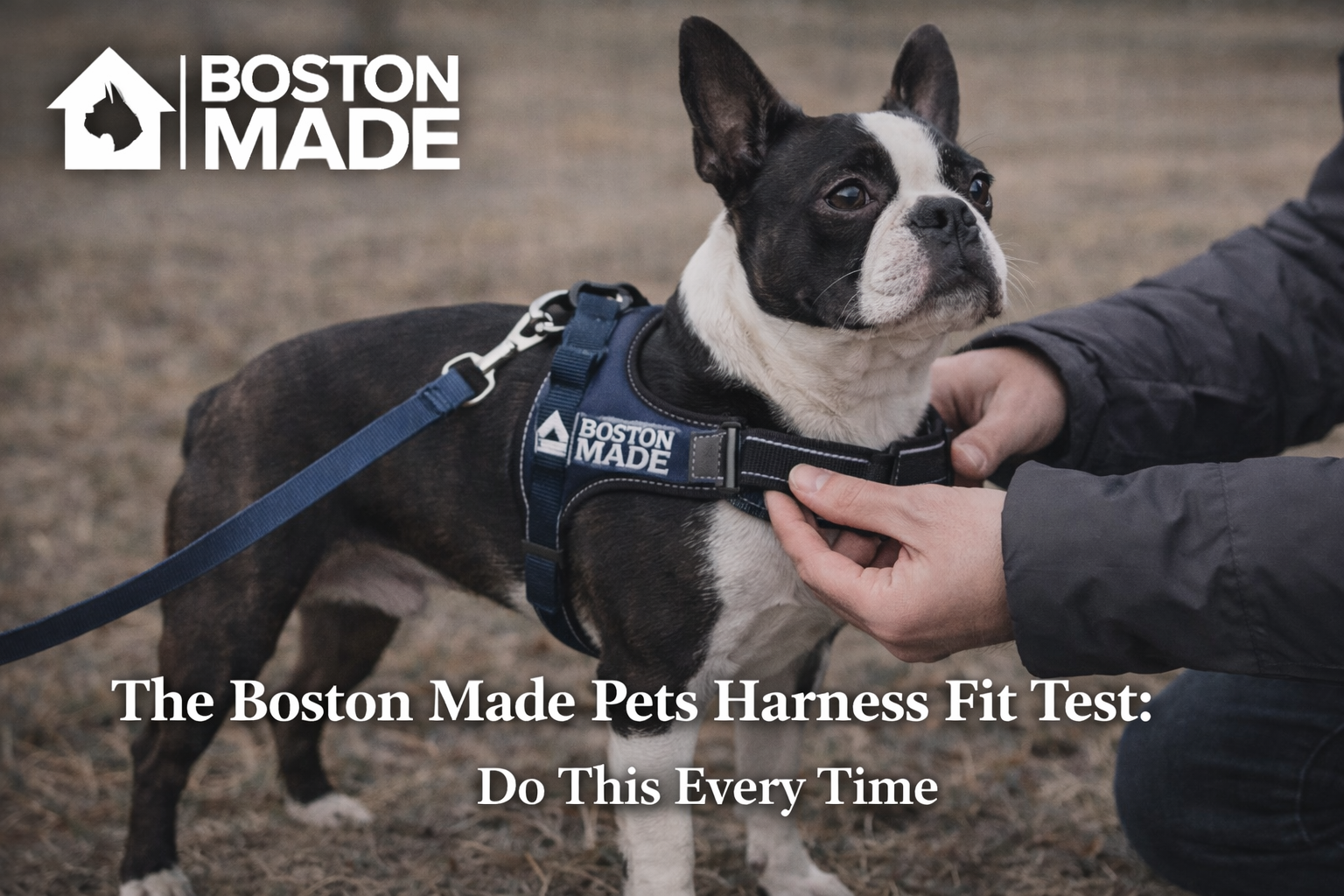
✅ Test #1: The Two-Finger Rule (But Done Correctly)
Most people have heard “two fingers should fit under the strap.”
That’s true — but only if you’re testing the right spot.
Check these points:
- under the chest strap (behind the front legs)
- under the neck strap (but not pressing the throat)
- under any strap that rests across fur and skin
Pass = two fingers slide under with slight resistance
Too tight = you can’t get fingers under without force
Too loose = fingers slide easily and straps move around freely
✅ Test #2: The Shoulder Freedom Test
This is the one most brands never talk about.
Your dog’s shoulder blades must move freely — especially when walking fast, running, climbing, or jumping.
How to test:
- Put harness on
- Have your dog walk forward normally
- Watch the front legs and shoulders
Signs it’s too restrictive:
- short stride
- stiff movement
- “bunny hopping” (especially small breeds)
- dog stops and sits or refuses to walk
- dog suddenly becomes “lazy” only when harness is on
At www.bostonmadepets.com, we’re big on building wearables that move with the dog — not against them.
✅ Test #3: The Armpit Rub Check
A harness should never ride in the armpit.
What to check:
- After 5 minutes of walking, look at underarm area
- Separate the fur gently
- Check for red skin or friction
Red flags:
- redness
- missing fur
- wetness / irritation
- your dog licking the area repeatedly
- hesitation when you touch the harness straps
If that’s happening, don’t “wait and see.”
The fix is usually: different size, different adjustment, or a different harness shape.
✅ Test #4: The Pull and Shift Test
If your dog is a puller at all, the harness must stay stable.
Test it:
- hold leash like normal
- gently create tension
- observe the harness
Pass = stays centered and stable
Fail = slides sideways, twists, rides up
Twisting is not just annoying — it’s a sign that straps are applying uneven pressure.
At www.bostonmadepets.com, fit stability is one of our top priorities because stability equals comfort.
✅ Test #5: The Escape Test (VERY important)
This is the one that can prevent heartbreak.
Do this safely indoors:
- harness on
- hold chest straps
- allow your dog to back up slowly
If the harness can slip off their head:
- it’s too loose
- or it’s the wrong style for your dog’s body type
Some dogs (especially slim-chested breeds and anxious rescue dogs) need escape-resistant fitting more than others.
Signs Your Dog’s Harness Is Too Tight
Here’s the straight checklist.
If your dog shows any of these signs, the harness is likely too tight:
- heavy panting within minutes (when not hot)
- harness leaves deep indentations in the fur
- dog freezes when harness is clipped
- dog tries to chew or scratch it off
- red skin after removal
- decreased interest in walks (when harness is on)
- stiffness or short stride
If you’re seeing those signs, it’s time for an adjustment or a better fit.
Signs Your Dog’s Harness Is Too Loose
Loose harnesses create:
- chafing
- shifting
- twisting
- anxiety (because it feels unstable)
- and worst of all — escape potential
Signs it’s too loose:
- harness slides to the side
- dog can step out of it
- chest panel shifts left/right
- you can pull the straps away easily
- the harness rides up toward the neck during walking
How to Adjust a Harness the Right Way (Simple Method)
At www.bostonmadepets.com, we recommend adjusting harnesses in this order:
Step 1: Start with the chest strap
Make sure it sits behind the front legs, not in the armpits.
Step 2: Adjust the neck/upper strap next
Keep it away from the throat — you want it on the upper chest.
Step 3: Check symmetry
Left and right straps should match.
Step 4: Re-check after a 2-minute walk
A dog’s body moves differently in motion than standing still.
Why Boston Made Pets Cares So Much About Fit
Because fit is not just physical — it’s emotional.
When wearables fit well:
- dogs move naturally
- dogs act confident
- walks feel easier
- owners feel safer
- and dogs stop resisting getting dressed
At www.bostonmadepets.com, we build wearables with a long-term goal:
Make comfort the standard — not a luxury.
Because every dog deserves gear that feels like it was made for them.
Final Thought: Fit Is Love in a Practical Form
There’s something powerful about caring enough to get the fit right.
It’s saying:
- “I want you comfortable.”
- “I want you safe.”
- “I want this to feel good for you.”
And that’s what Boston Made Pets exists for.
If you want more guidance, fit education, and custom wearable design inspiration, keep exploring www.bostonmadepets.com — we’re building the kind of resource we wish existed years ago.