

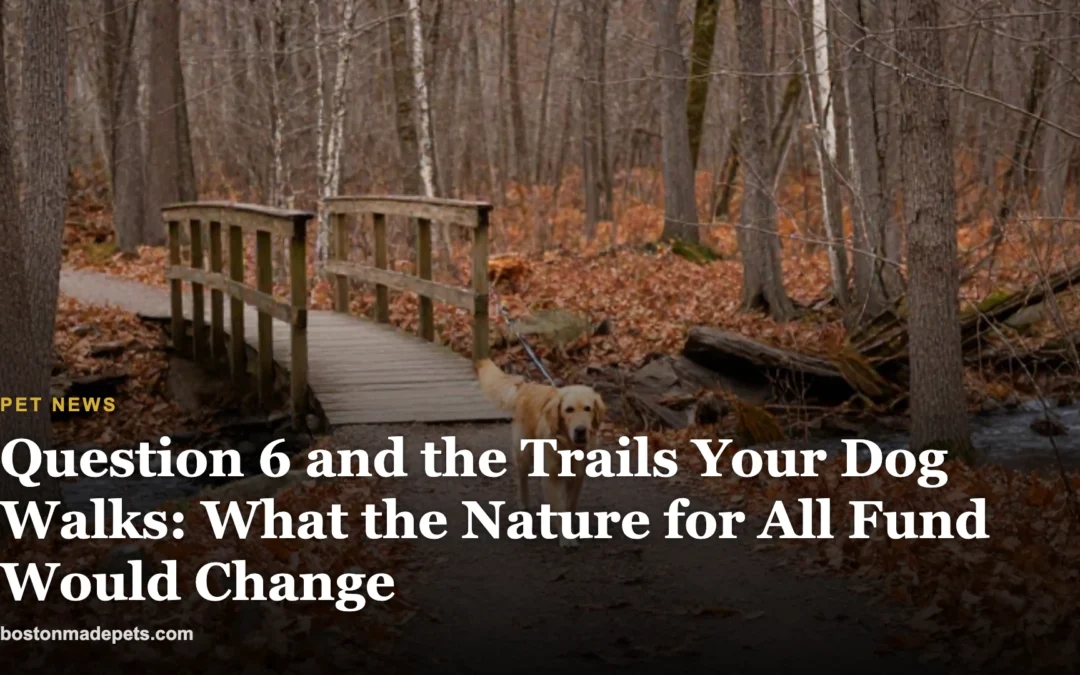
Every morning across Greater Boston, thousands of dogs and their people head for the same places: state reservations, town conservation land, riverfront paths and neighborhood parks. On Tuesday, Nov. 3, Massachusetts voters will decide a ballot question that could change how those places are paid for.
Question 6 would create what supporters call the Nature for All Fund, a dedicated pot of money for land and water conservation, parks, trails and outdoor access. It is not a pet question on its face, and the word “dog” does not appear in the official summary. But for anyone whose daily routine runs through a trailhead parking lot, it is worth understanding before heading to the polls.
What Question 6 would do
According to the City of Boston’s ballot guide, CBS Boston and the Greenfield Recorder, the measure would:
- Redirect existing sales tax, not create a new one. The fund would draw on sales and use taxes the state already collects on sporting goods, recreational vehicles and golf courses. Revenue earmarked for the MBTA and the Massachusetts School Building Authority would be excluded, the Recorder reported.
- Phase in over two years. Half of that revenue would go to the fund starting July 1, 2027, rising to the full amount on July 1, 2028.
- Pay for conservation and access. Eligible uses include drinking water protection, forest and farmland restoration, park and trail improvements, coastal protection and expanded outdoor recreation access.
- Be overseen by a 15-member board. Five seats would go to state officials, including the commissioners of conservation and recreation and of fish and game, and the governor would appoint 10 members of the public.
Estimates of the fund’s size vary. CBS Boston reported it could top $65 million a year, while the Recorder cited an estimate of about $100 million a year once fully phased in. The difference largely reflects the phase-in and assumptions about future sales.
The arguments on each side
Supporters, a coalition of more than 100 conservation and environmental groups including the Conservation Law Foundation and Mass Audubon, argue that Massachusetts has underfunded land and water protection for decades. They point to a state goal of conserving 30 percent of natural lands and waters by 2030 and 40 percent by 2050; the state reported about 28 percent conserved as of 2025, according to the Recorder. Diana Chaplin of the Connecticut River Conservancy told the paper that conservation money is especially tight right now.
Opponents, including the Massachusetts Fiscal Alliance and some forest-protection groups, argue that carving out a dedicated stream of existing tax revenue would shrink the Legislature’s flexibility and could lead to new taxes elsewhere. The Fiscal Alliance also warned that broad language in the measure could let money drift to projects beyond core conservation, CBS Boston reported. Janet Sinclair of Save Massachusetts Forests told the Recorder that “so many other things” deserve the money more.
No widely reported public poll has focused on Question 6, so its outcome is harder to read than some of this year’s more heavily polled questions.
Where dogs come in
The measure does not mention dog parks, off-leash areas or pets, and voters should not assume any specific project would be funded. Spending decisions would be made later by the board under rules it writes. Still, many of the categories it lists overlap with places Boston-area dog owners use every day:
- Trails and parks. State reservations and town conservation land are where many Greater Boston dogs get their longest walks. Trail repairs, drainage work and parking access are the kinds of maintenance that often lag when budgets are tight.
- Water quality. Stormwater projects can reduce the runoff that periodically makes rivers, ponds and harbor beaches unsafe for swimming dogs after heavy rain.
- Invasive species and forest health. Healthier woods with fewer tangled invasives can mean clearer paths and better visibility on walks.
One point matters to every pet owner: the question does not change any leash law, park rule or dog licensing requirement. Those stay with the state agencies, cities and towns that set them now.
Election Day with a dog
For the trip to the polls itself, a little planning helps. Service animals are permitted in polling places under the Americans with Disabilities Act. For pet dogs, rules vary by building, and many polling sites are schools and municipal buildings that do not allow pets inside. The simplest choice for most owners is to walk the dog first and vote alone, or bring a second adult who can wait outside with the dog. Lines can be longest early in the morning and after work, and polls close at 8 p.m.
The Boston Made Pets Take
Boston Made Pets takes no position on how readers should vote. The publication’s view is that Question 6 is a fiscal policy choice dressed in green: whether Massachusetts should lock in a steady stream of existing tax revenue for land, water and outdoor access, or keep that money flexible in the general budget. Reasonable people who love the outdoors land on both sides.
What Boston Made Pets does want readers to see is the connection between budget lines and daily life with a dog. The quality of a morning walk depends on trail upkeep, safe water, parking at the trailhead and open space close to home. Those things are rarely front-page issues, but they are funded somewhere. Whether through Question 6 or through the regular state budget, dog owners have a stake in how that money is spent and should feel free to tell their local conservation commissions and state representatives which places matter most to them.
What it means for you
- Read the full text of Question 6 in the Secretary of the Commonwealth’s voter guide before you vote; polls close at 8 p.m. Tuesday.
- Don’t expect overnight change. Money would not begin flowing until July 2027, and projects would follow the board’s rules.
- Leash and park rules stay the same under either outcome.
- Plan your polling-place trip so your dog stays home or outside with another adult, unless it is a service animal.
- Speak up locally. Whatever happens Tuesday, town meetings and conservation commissions decide much of what happens on local trails.
Test yourself
Does Question 6 create a new tax?
Answer: No. It would redirect existing sales tax collected on sporting goods, recreational vehicles and golf courses.
When would money first flow to the fund?
Answer: July 1, 2027, at 50 percent, rising to 100 percent on July 1, 2028.
How many members would sit on the fund’s board?
Answer: Fifteen: five state officials and 10 public members appointed by the governor.
Would Question 6 change Massachusetts leash laws?
Answer: No. Leash and park rules are set separately by state agencies and municipalities.
Discussion
- Which park or trail near you would you most like to see improved for walks with your dog?
- Is dedicating tax revenue to one purpose a smart guarantee or a budget straitjacket?
- Should future conservation spending set aside money specifically for off-leash areas?