

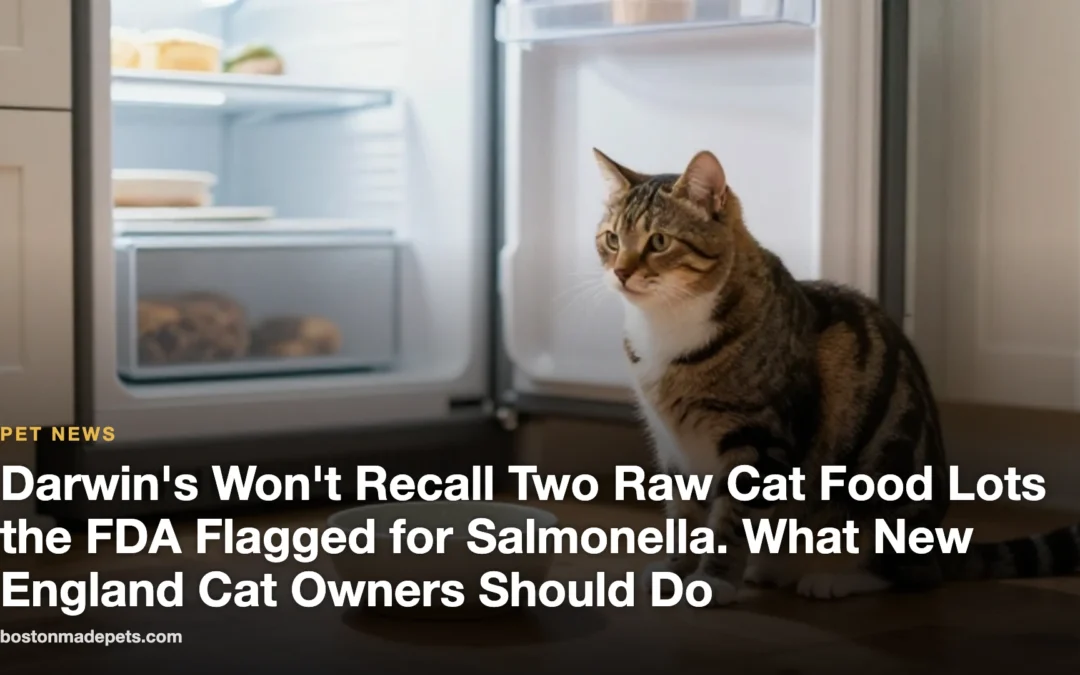
If there is a bag of Darwin’s raw chicken cat food in your freezer, take a minute to check the lot code before the next meal. The U.S. Food and Drug Administration says two lots of Darwin’s Natural Pet Products Natural Selections Chicken Recipe for Cats tested positive for Salmonella after two cats got sick. The agency asked the manufacturer to recall them. As of the latest reports, the company had not done so.
Darwin’s sells its frozen food online by subscription and ships nationwide, so the advisory reaches cat households across Greater Boston and New England as much as anywhere. Because the product carries no expiration date, the FDA warns that affected packages may still be sitting in home freezers months after they were made.
What is confirmed
Food Safety News and the veterinary trade publication dvm360 both reported the same core facts from the FDA’s advisory, which was issued Oct. 26:
- The product: Darwin’s Natural Pet Products Natural Selections Chicken Recipe for Cats, sold frozen in 2-pound packages divided into four units. The lot code appears on the front of the lower-left unit.
- The lots: Lot 12731, made July 8, 2026, and Lot 12493, made April 2, 2026.
- The illnesses: A consumer reported that two cats developed gastrointestinal illness after eating the food. One was hospitalized. Both recovered after the food was stopped.
- The recall status: The FDA recommended that Arrow Reliance Inc., which does business as Darwin’s, recall both lots. Food Safety News reported that the firm refused; dvm360 said the company had not started an adequate recall.
The company’s side
Darwin’s disputes the FDA’s approach. In an Oct. 13 statement cited by dvm360, owner Gary T. Tashjian called the agency’s zero-tolerance policy for Salmonella in raw pet food “an arbitrary standard.” The company says it notifies affected customers directly rather than issuing public recalls.
That disagreement is not new. In August, the U.S. Department of Justice filed a civil complaint seeking to permanently bar Arrow Reliance and Tashjian from making and selling adulterated pet food, according to both outlets. Food Safety News reported that the complaint cites a 4-year-old boy who developed kidney failure, with matching bacteria found in his family’s unopened Darwin’s food. The case has not been decided, and the allegations have not been proven in court.
dvm360 counted this as at least the eighth FDA advisory about Darwin’s products since 2018. Food Safety News, citing FDA records, reported 49 consumer complaints about sick pets fed Darwin’s raw food between 2016 and January 2026. Those figures come from complaint records and do not, on their own, establish that the food caused each illness.
Why Salmonella in cat food matters to people, too
Cats can carry and shed Salmonella without looking sick, and the bacteria can spread to people through handling food, bowls, litter and surfaces. That is a particular concern in homes with young children, older adults or anyone with a weakened immune system. Freezing does not help: the FDA notes that neither freezing nor refrigeration kills the bacteria, which is why a frozen product can stay risky for as long as it sits in the freezer.
The Boston Made Pets Take
Boston Made Pets takes no position on whether raw diets are right for every cat. Many owners choose them carefully, and many veterinarians raise concerns about them. What this case highlights is narrower and more practical: when a manufacturer declines to issue a public recall, the job of finding affected food falls on the owner.
A subscription model makes that harder. Food that arrives automatically and is stacked in a freezer is easy to forget, and without an expiration date there is no natural moment to throw old packages away. Owners who feed any raw product should treat lot codes the way they treat a vaccine record: something worth writing down.
The dispute also shows the limits of the current system. The FDA can recommend a recall and warn the public, but a company that disagrees can decline, leaving the courts to sort it out. In the meantime, owners are left to read advisories and act on their own.
What it means for you
- Check the freezer today. Look for Lot 12731 or Lot 12493 on the lower-left unit of any 2-pound Darwin’s chicken cat food package. If the code is missing or unreadable, the FDA says to throw it out.
- Dispose of it safely. Seal it in a container wildlife and other animals cannot reach. Do not donate it to a shelter or a neighbor.
- Clean thoroughly. Disinfect bowls, utensils, counters, floors, bedding, toys and the freezer itself, and scoop the litter box promptly.
- Watch your cat. Vomiting, diarrhea, lethargy or loss of appetite are reasons to call your veterinarian and mention the food.
- Report problems. Suspected illnesses can be reported through the FDA’s Safety Reporting Portal.
Test yourself
Which two Darwin’s lot numbers did the FDA flag?
Answer: Lot 12731 and Lot 12493.
Does freezing raw pet food kill Salmonella?
Answer: No. The FDA says freezing and refrigeration do not kill it.
Where is the lot code printed on the package?
Answer: On the front of the lower-left unit of the four-unit, 2-pound package.
What should you do with affected food?
Answer: Throw it away in a secure container that animals cannot get into, and do not donate it.
Discussion
- Should the FDA have the power to order pet food recalls when a company refuses?
- Do the benefits some owners see in raw diets outweigh the food safety risks?
- How do you keep track of lot numbers and recalls for the food your pets eat?
From the network
Sources
- Food Safety News: FDA issues another warning against Darwin’s pet food; firm refuses to initiate recall (Oct. 27, 2026)
- dvm360: FDA finds Salmonella in 2 lots of Darwin’s raw cat food after cat is hospitalized (Oct. 27, updated Oct. 29, 2026)
- U.S. Food and Drug Administration: Advisory on two lots of Darwin’s Natural Pet Products Chicken Recipe cat food (Oct. 26, 2026)