

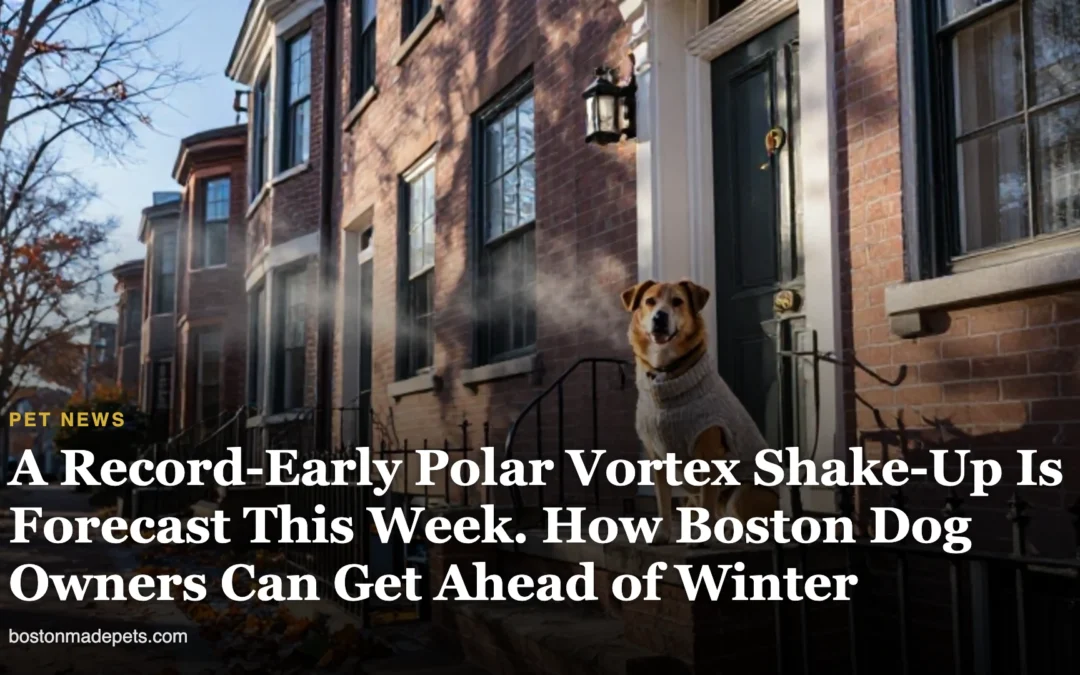
Something unusual is happening about 10 to 30 miles above the Arctic, and it could shape what Boston dogs and their people walk through later this month. Forecasters say the polar vortex, the band of strong winds that circles the North Pole high in the stratosphere, is on track for a major disruption in the first week of November. If it happens, it would be the earliest such event on record by roughly three weeks, according to the Boston Globe, Fox Weather and Severe Weather Europe.
That does not mean a deep freeze is headed for Back Bay on Wednesday. It does mean that the second half of November and early December deserve a closer look than usual, and that a few weeks of lead time is a gift for anyone who shares a home with a short-coated dog, a senior pet or a cat that likes to slip outside.
What forecasters are seeing
The Globe reported on Oct. 28 that the vortex’s winds could slow sharply and possibly reverse around Nov. 4 or 5. Severe Weather Europe, citing the European ECMWF ensemble, put the chance of a wind reversal by Nov. 11 at 96 percent, while the American GEFS model showed 71 percent. The previous earliest major breakdown came around Nov. 28.
MIT research scientist Judah Cohen, who studies the vortex, told Fox Weather this is “almost undoubtedly, the largest, earliest disruption of the polar vortex on record,” while stressing that its timing, strength and eventual impacts remain uncertain.
What it could mean for New England
Changes in the stratosphere usually take a couple of weeks or more to reach the weather people feel on the ground. The Globe’s weather writer pointed to the second half of November into early December as the period to watch, when a wavier jet stream could let occasional cold snaps reach the Northeast. If one of those snaps coincides with a storm, interior New England could see early-season snow.
There are important counterweights. A strong El Niño is in place, which generally favors a milder winter in the eastern United States, and the federal Climate Prediction Center’s outlook shows a warmer-than-average New England during the middle weeks of November, the Globe reported. The Globe’s forecast does not call for a deep freeze, and much of the coldest air may spill into Europe and Asia instead. In other words, the signal is for more variety, not a guaranteed arctic winter.
The calendar adds its own twist. Clocks fell back an hour early this morning, so the evening walk now happens in the dark for most working households, right as the cold-weather season gets its start.
The Boston Made Pets Take
Boston Made Pets sees this forecast as a reason to prepare early rather than a reason to worry. The most dangerous days for pets in a New England winter are often the first sharp cold snaps, when coats have not been pulled out of storage, ice melt has not been bought and dogs have not yet adjusted. A record-early stratospheric event that may bring a wavier, more changeable pattern in late November is a good prompt to get those basics done in the mild weeks before it arrives.
The American Veterinary Medical Association’s cold-weather guidance offers a practical checklist. It recommends asking a veterinarian about a pet’s specific risks, considering a sweater or coat for short-coated dogs, making sure booties fit properly, shortening walks when temperatures are very low and calling a vet if a pet shivers or seems unusually sluggish after time outside. It also advises using pet-safe de-icers, cleaning up antifreeze spills right away, keeping pets off frozen ponds and streams, and wiping paws, legs and bellies after walks to remove salt and chemicals. Before starting a car on a cold morning, the AVMA suggests tapping the hood or honking to rouse any animal sheltering underneath.
Boston Made Pets would add one local point: city sidewalks get treated early and often, so the de-icer question is not limited to what goes on a family’s own steps. Checking paws after every walk, not only after snowstorms, is the habit that matters most in an urban winter.
What it means for you
- Use the mild weeks: fit coats and booties now, while dogs can get used to them on comfortable walks.
- Stock up before the first cold snap: pet-safe ice melt, paw balm and towels by the door are easier to buy before stores run low.
- Check the garage: clean up antifreeze drips and store containers out of reach.
- Book wellness visits early: senior and arthritic dogs often feel the cold first, so ask a vet about winter comfort plans.
- Light up evening walks: with sunset earlier after the clock change, add a reflective leash or clip-on light.
Test yourself
Around what date could the polar vortex’s winds reverse, according to the Globe?
Answer: Around Nov. 4 or 5.
When was the previous earliest major polar vortex breakdown?
Answer: Around Nov. 28.
Which climate pattern generally favors a milder winter in the eastern U.S.?
Answer: A strong El Niño, which is in place this year.
What does the AVMA recommend after winter walks?
Answer: Wipe or wash your pet’s paws, legs and belly to remove snow, ice, salt and de-icing chemicals.
Discussion
- Does your dog wear a coat or booties in winter, and how long did it take to get used to them?
- Should Boston and neighboring towns use more pet-safe de-icers on public sidewalks?
- How do you change your dog’s routine once evening walks move into the dark?
From the network
Sources
- The Boston Globe: The polar vortex shows signs of a rare early weakening. Here’s what that means for New England. (Oct. 28, 2026)
- Fox Weather via Yahoo News: Historic polar vortex disruption could arrive earlier than ever (Oct. 28, 2026)
- Severe Weather Europe: Polar vortex split forecast, the earliest stratospheric warming on record (Oct. 28, 2026)
- American Veterinary Medical Association: Cold weather safety for pets