

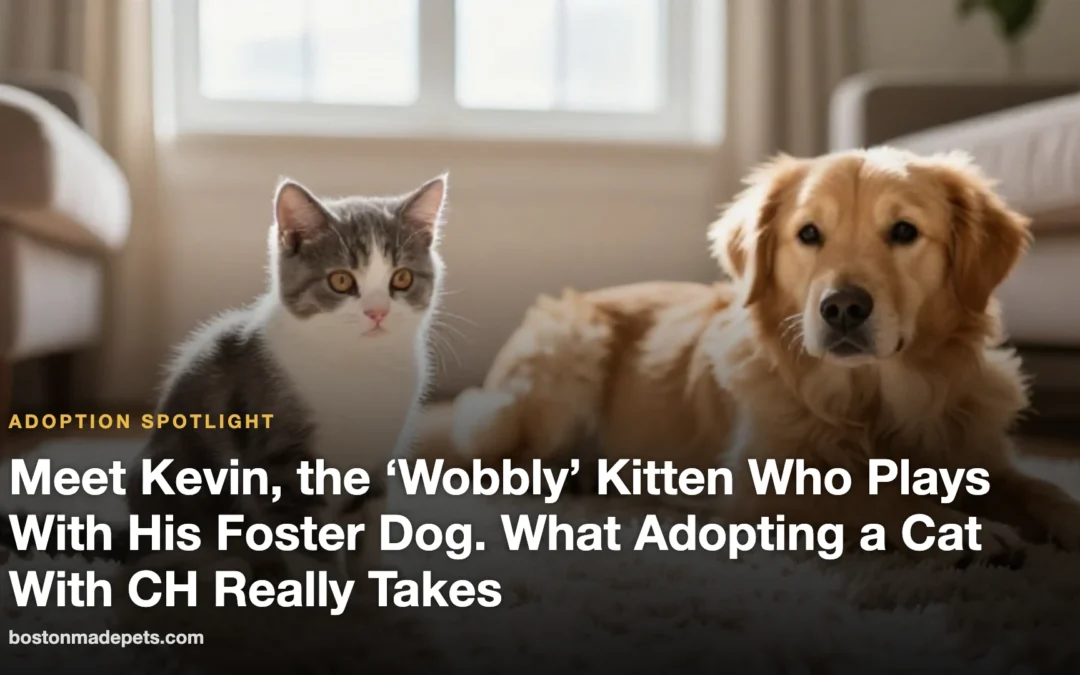
Kevin walks a little differently than most kittens. The 12-week-old gray-and-white tabby, now in foster care with the Animal Rescue League of Boston, sways, wobbles and sometimes trembles as he moves. None of that has slowed him down at home, where he shares space with a dog, another cat and a child and plays with all three, according to the shelter. On October 29, ARL announced that Kevin is looking for an adopter.
Kevin has a moderate form of cerebellar hypoplasia, or CH, a neurological condition often nicknamed wobbly cat syndrome. For Boston-area households that already have a dog, his story is a useful look at a kind of special-needs adoption that sounds more daunting than it usually is.
What the shelter says about Kevin
According to ARL, Kevin has been examined by its veterinary team and is up to date on vaccinations, neutered and microchipped. The shelter says his condition affects coordination and balance, with symptoms such as uncoordinated movement, swaying and head tremors. ARL describes the ideal match as a patient adopter “willing to make some adjustments to help him thrive,” and says another playful animal in the home would help him learn boundaries.
The adjustments ARL lists are modest: soft, non-slip surfaces, limited access to stairs, raised food and water bowls, an easy-to-reach litter box and regular nail trims. The listing is on ARL’s adoption pages under the ID A301801, and the shelter’s Boston, Dedham and Cape Cod adoption teams can start the process.
What cerebellar hypoplasia is, and is not
The cerebellum is the part of the brain that controls balance and coordinated movement. In cats with CH, it never fully develops. The Cornell Feline Health Center and WebMD both identify the most common cause as infection with feline panleukopenia virus, a feline parvovirus, while kittens are still in the womb. The virus damages the developing cerebellum before birth, so affected kittens show signs once they begin walking, typically at two to three weeks old, WebMD notes.
Three points matter most to would-be adopters, and both sources agree on all of them:
- It does not get worse. CH is non-progressive. Many cats actually move better over time as they learn to rely on vision and body awareness, according to WebMD.
- It is not contagious. A cat with CH cannot pass the condition to other cats, and it poses no risk to dogs or people.
- It is not painful and does not shorten life. Cornell says affected cats can live happy lives with some changes to their environment.
There is no cure or medication for CH. Care is about the setting: padded areas, high-sided litter boxes, shallow and stable bowls and keeping the cat indoors, Cornell advises. One detail differs between sources: ARL recommends regular nail trims, while WebMD says leaving claws untrimmed can help some CH cats grip. That is a good question to settle with a veterinarian once Kevin is home.
Why the dog in his foster home matters
Kevin already living with a dog is a meaningful detail. Many Boston Made Pets readers are dog-first households wondering whether a cat could fit in. A kitten who is comfortable around a dog, and who benefits from a playful companion, removes one of the biggest unknowns in a cat-dog introduction.
Owners should still go slowly. A wobbly kitten cannot always scramble away as fast as a typical cat, so the household dog needs to be calm and supervised during early meetings, and the kitten needs escape spots at floor level, since tall cat trees and high perches may not suit him. Feeding the two animals separately and gating off stairs can protect both. ARL’s adoption counselors can share how Kevin and his foster dog interact.
The Boston Made Pets Take
Boston Made Pets views Kevin’s listing as a reminder that “special needs” covers a wide range. Some conditions bring medication schedules, frequent vet visits and real costs. Cerebellar hypoplasia, by the accounts of a major veterinary school and the shelter itself, is closer to a mobility difference: it changes how a cat moves, not how long or how well it lives. Adopters who can offer a rug instead of hardwood and a low litter box instead of a covered one may find the commitment smaller than the label suggests.
The desk also sees a public-health lesson in the cause. Because CH usually traces back to panleukopenia during pregnancy, Cornell notes that it can be prevented by vaccinating female cats before they become pregnant. Every spayed, vaccinated cat in Greater Boston makes stories like Kevin’s less common.
What it means for you
- Thinking about adopting Kevin? Look up listing A301801 on ARL’s adoption pages and contact the Boston, Dedham or Cape Cod adoption team.
- Have a dog? Ask ARL how Kevin behaves with his foster dog, and plan supervised introductions and separate feeding areas.
- Preparing a home? Add soft, non-slip surfaces, gate the stairs, raise or stabilize bowls and choose a low-entry litter box.
- Have an unspayed female cat? Talk to your veterinarian about panleukopenia vaccination; Cornell says vaccinating before pregnancy prevents the infection that causes most CH.
Test yourself
Which part of the brain is underdeveloped in a cat with cerebellar hypoplasia?
Answer: The cerebellum, which controls balance and coordination.
What is the most common cause of CH in kittens?
Answer: Feline panleukopenia virus infecting the kittens before birth.
Does CH get worse as a cat ages?
Answer: No. It is non-progressive, and many cats compensate better over time.
Which animals share Kevin’s foster home?
Answer: A dog and another cat, along with a child.
Discussion
- Would you consider adopting a pet with a mobility condition like CH? What would make you more confident?
- If you have a dog, what helped (or would help) a cat settle into your home?
- How can shelters do a better job of explaining which special needs are manageable for first-time adopters?